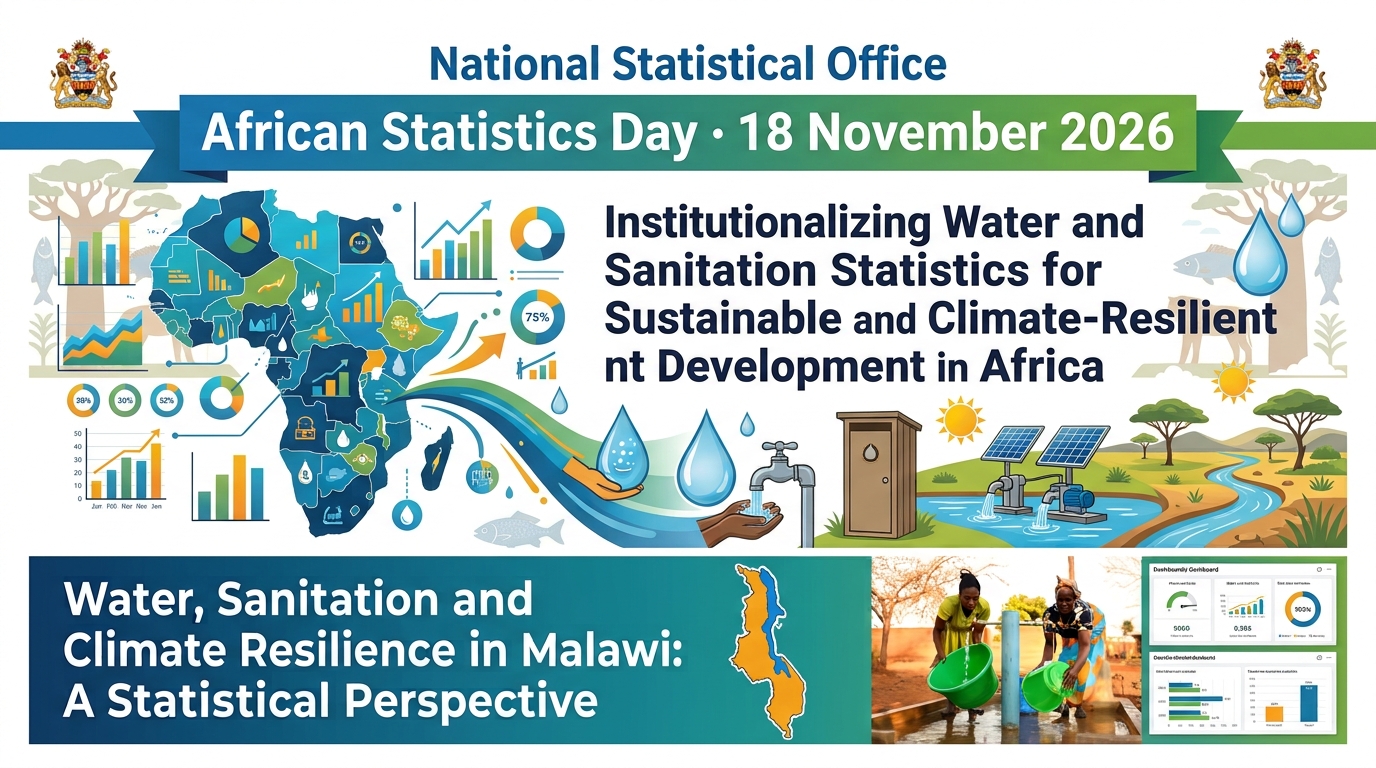
African Statistics Day · 18 November 2026
1. Background
African Statistics Day (ASD) is celebrated every year on
18 November to raise public awareness of the importance of statistics in all
areas of social and economic life. The day was initiated in 1990 following a
decision by African Ministers responsible for Planning and Economic
Development, under the auspices of the United Nations Economic Commission for
Africa (UNECA). In 2026, the ASD will be celebrated under the theme “Institutionalizing
Water and Sanitation Statistics for Sustainable and Climate-Resilient
Development in Africa”. The theme emphasizes the importance of establishing
sustainable systems and institutional arrangements for the regular production,
management, dissemination and utilization of reliable water and sanitation statistics.
It calls for stronger collaboration among government institutions, data
producers, data providers and other stakeholders, so that relevant, timely and
quality data are always available to support planning, policy formulation and
decision-making.
Malawi’s development aspirations are closely linked to sustainable
access to water, sanitation and hygiene, environmental protection and
resilience to climate change. The Malawi 2063 (MW2063), the country’s long-term
development vision, seeks to transform Malawi into an inclusively wealthy and
self-reliant industrialized upper-middle-income country. Among its key
development enablers is Environmental Sustainability, which recognizes the
importance of sustainable management of natural resources, environmental
protection and resilience to climate change. These priorities are also closely
linked to the Vision’s pillars of Agricultural Productivity and Commercialization,
Industrialization and Urbanization, all of which depend on reliable water
resources, adequate sanitation infrastructure and a sustainable environment.
At the continental level, the African Union’s Agenda 2063,
particularly Aspiration 1, envisions a prosperous Africa based on inclusive
growth and sustainable development. It emphasizes improved living standards and
access to basic services, including water and sanitation, as well as
environmentally sustainable and climate-resilient economies and communities.
Similarly, the Sustainable Development Goals (SDGs), particularly SDG 6 (Clean
Water and Sanitation), SDG 13 (Climate Action), SDG 11 (Sustainable Cities and
Communities) and SDG 15 (Life on Land), underscore the importance of ensuring
sustainable water management, improving sanitation and hygiene, strengthening
climate resilience and protecting ecosystems.
This article examines the state of water, sanitation and climate
resilience in Malawi, drawing on findings from the Integrated Household Survey
(IHS) 2025 and the Malawi Demographic and Health Survey (MDHS) 2024. It
highlights progress made, the challenges that remain and differences in access
across population groups and geographical areas. It also demonstrates the
importance of reliable statistics in understanding these challenges and
informing efforts to improve water and sanitation services while strengthening
climate resilience in Malawi.
2. The State of Water Access
Key indicators
|
91.2 per cent of households use an improved
drinking-water source |
|
8.9 per cent of the population use safely
managed drinking water |
|
74.6 per cent of the population have
contaminated drinking water at home
|
|
|
|
|
|
|
|
40.2 per cent of the population have at
least basic sanitation service |
|
49.9 per cent of households reported drought
in the last five years
|
|
65.6 per cent of households experienced five
or more shocks of any type in five years
|
Water is a fundamental resource for human survival,
economic development and environmental sustainability, and access to safe and
reliable drinking water remains a critical development priority for Malawi.
About 91.2 per cent of households use an improved drinking-water source, such
as a borehole, a protected well or a tap (IHS, 2025). Access has expanded in
every survey round since 2010/11, as Figure 1 shows, although the pace of
improvement has slowed in recent years. Reaching the Malawi 2063 milestone of
universal access by 2030 will therefore require faster progress, particularly
among the households that still lack an improved source.
Figure 1: Households with an
improved drinking-water source, Malawi, 2010/11 to 2025

Source: National Statistical
Office, IHS, 2010/11 to 2025.
Having an improved source does not guarantee that water
is safe, available when needed and close to home. Only 8.9 per cent of the
population uses safely managed drinking water, the highest level of service,
which requires water from an improved source that is on the premises, available
when needed and free from contamination (MDHS, 2024). A larger share, 72.5 per
cent, has at least basic service, meaning an improved source on the premises or
within a round trip of 30 minutes or less. The gap between urban and rural
areas is wide. At least basic service reaches 93.2 per cent of the urban
population but 68.9 per cent of the rural population. For many rural
households, an improved source does not mean water that is readily available at
home or reliably safe, which affects health, daily activities and the time
spent collecting water, particularly by women and children. Closing the gap
will therefore require more than adding improved water sources. It will also
require bringing reliable services closer to households and ensuring that the
water supplied is safe to drink.
Figure 2 shows access to safely managed drinking water.
Although many people using improved sources report that water is available when
needed and free from contamination at the source, only 16 per cent have a water
source on their premises. This means that many households still have to travel
to collect water, making access less convenient and placing an additional
burden on household members responsible for water collection. The situation is
even more difficult for poorer households. Only 1.8 per cent of people in the
poorest households have safely managed drinking water, compared with 31.4 per
cent in the wealthiest households. This difference highlights how access to
reliable water services is closely linked to household living conditions and
ability to afford better services. Improving access will therefore require
particular attention to rural and low-income communities, where households face
the greatest barriers. Expanding piped water supplies, improving existing water
systems and ensuring regular water quality monitoring and maintenance will be
important in making safe and reliable drinking water accessible to more
Malawians. These efforts are also essential for Malawi to make progress towards
SDG 6.
Figure 2: Availability and quality drinking-water sources, Malawi 2024

Source: National Statistical Office,
MDHS, 2024.
3. Water Quality, Availability and the Burden of Water
Collection
Is the water safe to drink?
Even where people use an improved source, the water they
drink is often not safe. Faecal contamination, which shows that water may have
come into contact with human or animal waste, was found in the drinking water
of 74.6 per cent of the population when it was tested in the household,
compared with 35.0 per cent when it was tested at the source. Contamination
therefore increases substantially between the source and the home. Figure 3
shows that this happens for every type of source. Households with piped water
have a much higher share of contaminated water at home than at the source, and
the same is true of boreholes, which most Malawian households use. Water can
become contaminated during transport, handling and storage, so a protected
source does not guarantee safe water at the point of drinking, and investment
in sources must be matched by safe storage, good hygiene and household
treatment. Protected dug wells are a separate concern, because their water is
already heavily contaminated at the source.
Figure 3: Faecal contamination of
drinking water, by type of source, Malawi, 2024

Source: National
Statistical Office, MDHS, 2024.
The problem is more serious for rural households, which
are more likely to use contaminated drinking water. This puts already
vulnerable communities at greater risk of water-related illnesses and
highlights the need to improve water quality both at the source and within
households. Household water treatment remains limited, leaving many people
exposed to unsafe drinking water. More than half of the population live in
households that do not treat their drinking water, while only 32.4 per cent use
methods such as boiling, chlorination, filtration or solar disinfection
(MDHS,2024).
Encouraging these simple treatment methods, alongside
improvements in water supply systems, could help reduce exposure to
contamination. This is particularly important because contaminated drinking
water can contribute to diarrhoeal diseases and other public health problems. The
availability of water is another concern. Although most people reported having
enough drinking water in the month before the survey, households that travel
longer distances to collect water were more likely to experience shortages.
Limited water availability affects more than drinking needs. It can also
restrict cooking, cleaning and personal hygiene, increasing the risk of poor
health and living conditions.
Who collects the water?
When water is not available at home, household members
must spend time collecting it, and this responsibility often falls on women and
girls. As shown in Figure 4, adult women are the main water collectors in most
households, while girls under the age of 15 also take part of this
responsibility. This can take time away from other activities, including
education, paid work and household responsibilities. The burden is particularly
pronounced in rural areas, where access to water within or near the home
remains limited. Malawi 2063 recognizes that gender inequality limits women's
access to infrastructure and services and commits to advancing gender equality.
Bringing water closer to homes is one of the clearest ways to put that
commitment into practice, and it shows how better water services can deliver
benefits well beyond the water sector.
Figure 4:
Person who usually collects drinking water, Malawi, 2024

Source:
National Statistical Office, MDHS, 2024.
4. Sanitation and Hygiene Services
Access to toilet facilities
Sanitation coverage remains considerably lower than access to
improved drinking water. While 91.2 per cent of households have an improved
water source, only 54.2 per cent have an improved toilet (IHS, 2025). As shown
in Figure 5, this gap is evident in both urban and rural areas, but is more
pronounced in rural communities. This suggests that progress in expanding water
access has not been matched by similar improvements in sanitation. Most
improved toilet facilities are pit latrines with a slab, meaning that basic pit
latrines remain the main form of improved sanitation in Malawi. However, many
households, particularly in rural areas, still rely on pit latrines without
slabs, while some have no toilet facility at all.
Figure 5: Improved
drinking water and improved toilets, by residence, Malawi, 2025

Source: National Statistical Office,
IHS, 2025.
Access to improved sanitation also varies considerably
between districts. Although differences across the three regions are relatively
small, some districts have much better coverage than others. For example,
access ranges from very low levels in Phalombe (15.2%) to much higher levels in
Lilongwe City (84.2%). These differences show that national progress can
conceal communities where sanitation remains a serious challenge. Access to
water does not necessarily guarantee access to improved sanitation either.
Chiradzulu, for instance, has high coverage of improved drinking-water sources (99.4),
but a much smaller share of households has improved toilets (26.7%). This
highlights the need to address water and sanitation together while directing
resources towards districts and communities with the greatest gaps.
Is sanitation improving?
Sanitation progress in Malawi has not been sustained. The proportion
of the population using at least basic sanitation increased steadily between
2000 and 2015/16, but declined by 2024 (Figure 6). This reversal is a concern
because it suggests that improvements in sanitation access have not kept pace
with the country's needs. Addressing this challenge will require greater
attention to the availability, use and maintenance of improved sanitation
facilities, particularly in underserved communities. The challenge is also
reflected in Malawi 2063, which aims to increase the use of safely managed
sanitation to 74 per cent of households by 2030. Achieving this target will
require more than expanding access to basic toilet facilities. It will also
mean ensuring that sanitation waste is safely contained, emptied, transported
and treated. Strengthening sanitation services is therefore essential if Malawi
is to reverse the recent decline and make progress towards its national
development goals.
Figure 6:
Population with at least basic sanitation, Malawi, 2000 to 2024

Source: National
Statistical Office, MDHS, 2000 to 2024.
The quality of sanitation services
The type of toilet used is also important. While some
households have access to improved toilets, not all facilities are private or
adequately maintained. In Malawi, a considerable share of the population relies
on toilets shared between households, while others use unimproved facilities or
practice open defecation. Shared toilets are particularly common in urban
areas, where growing populations place pressure on available sanitation
facilities. Where many households depend on the same toilet, maintaining
cleanliness and ensuring safe and dignified use can become difficult,
especially for women, girls and other vulnerable groups.
Access to improved sanitation is also closely linked to
household income. People in poorer households are much less likely to have
access to private improved toilets, while open defecation is more common among
them. This means that those already facing difficult living conditions are also
more exposed to sanitation-related health risks. Improving sanitation must
therefore involve more than increasing the number of toilet facilities. Greater
attention is needed to making safe, affordable and accessible sanitation
available to low-income households and underserved communities. This is in line
with Malawi 2063, which emphasizes improved sanitation facilities and better
management of liquid and solid waste.
Excreta management and hygiene
Having a toilet does not necessarily mean that human
waste is safely managed. Although many households use improved sanitation
facilities, the safe disposal and treatment of waste remain important
challenges. About 68.8 per cent of the population manage excreta appropriately,
meaning that waste is safely disposed of on site, connected to a sewer or
removed for treatment elsewhere. Almost all of this is safe disposal on site,
since only 0.4 per cent of the population is connected to a sewer, and 96.5 per
cent of people using improved on-site facilities report that their latrine or
tank has never been emptied. This is particularly important in growing towns
and cities, where increasing populations place greater pressure on existing
sanitation facilities. Safe emptying, transportation and treatment of waste
must therefore form part of efforts to improve sanitation.
Good sanitation must also be supported by proper hygiene
practices. Access to basic handwashing facilities remains low, particularly in
rural areas, and many households lack either soap or water at their handwashing
places. This limits their ability to maintain good hygiene and prevent the
spread of diseases. Improving sanitation should therefore go hand in hand with
promoting handwashing and ensuring that households have reliable access to soap
and water. These simple measures are important in protecting public health and
reducing sanitation-related illnesses.
5. Climate-related Shocks and Household Vulnerability
Water
and sanitation services in Malawi are increasingly affected by climate-related
shocks, including droughts, irregular rainfall, floods and cyclones. These
events affect the availability of water and place additional pressure on
households that depend on agriculture and natural water sources. The situation
is particularly important in rural areas, where many households rely on
rainfall for farming and on water sources that are replenished by seasonal
rains.
In
Malawi drought and changes in rainfall patterns were among the most commonly
reported climate shocks (Figure 7). These conditions can reduce water
availability, affect agricultural production and make it harder for households
to meet their daily water needs. Their effects are often compounded by economic
pressures. High food prices, for example, were widely reported by households,
showing that climate-related challenges occur alongside rising living costs.
Together, these pressures can make it harder for households to recover from
shocks and maintain their livelihoods.
Figure 7: Households affected by
climate-related shocks in the last five years, Malawi, 2025

Source: National Statistical Office, IHS,
2025.
Exposure to climate-related shocks varies across the country, with
the Southern Region experiencing some of the greatest challenges (Figure 8).
Households in this region are more frequently affected by droughts, irregular
rainfall and cyclones. These conditions often lead to water shortages, while
floods can damage existing water and sanitation facilities. Rural households
are also more exposed to drought than urban households, partly because of their
dependence on rain-fed agriculture. These differences highlight the need to
direct climate resilience efforts towards the most affected communities. The
Southern Region and other highly exposed rural areas require greater attention,
particularly in preparing for extreme weather events. Water and sanitation
infrastructure must also be designed to withstand these conditions so that
communities can continue accessing essential services during climate-related
shocks.
Figure 8: Selected
climate-related shocks, by region, Malawi, 2025

Source:
National Statistical Office, IHS, 2025.
The effects of climate-related events are compounded by
other challenges facing households. Many families experience repeated shocks,
including economic difficulties and health problems, leaving them with limited
time and resources to recover before another crisis occurs. The burden is
particularly high in the Southern Region, where households are more frequently
exposed to multiple shocks. Urban communities also face health-related
challenges, including disease outbreaks such as cholera, which further increase
pressure on already vulnerable households. Addressing these challenges requires
disaster preparedness to be part of Malawi's broader development planning.
Malawi 2063 recognizes the importance of disaster risk reduction and climate
change adaptation. Strengthening early warning systems and providing support to
vulnerable households can help communities prepare for and recover from shocks.
Greater investment in climate-resilient agriculture is also important,
particularly in areas where droughts and floods frequently affect food
production.
6. Institutionalization of Water,
Sanitation and Climate Statistics in
Malawi
The findings presented in this article show that Malawi
has made progress in expanding access to improved water sources, but
significant challenges remain in sanitation, hygiene and resilience to
climate-related shocks. Addressing these challenges requires reliable information
to guide planning and investment. Water, sanitation and climate statistics need
to be regularly produced, properly coordinated and made accessible to the
institutions responsible for delivering services. This requires cooperation
among data-producing institutions, common standards and clear responsibilities
for maintaining and sharing information.
Why reliable statistics matter
Reliable and accessible statistics allow Malawi to plan
services, monitor progress and decide where to invest. The gaps described in
this article are not evenly spread. They are concentrated among rural and
poorer households, in particular districts and in the Southern Region, and the
priorities differ by place, since a district such as Chiradzulu has widespread
access to improved water but limited access to improved toilets. Without
statistics that are regular, comparable over time and available for small
areas, it is hard to tell whether a programme is working, where maintenance and
drought response are most needed, or which communities are most at risk from
the next flood. The Malawi 2063 Agenda itself names data gaps, weak
coordination between institutions and limited funding among the challenges to a
sustainable environment.
The role of the National Statistical Office and its partners
The National Statistical Office (NSO), as the
institution responsible for coordinating official statistics, has played an
important role in strengthening water, sanitation and climate statistics. This
includes promoting common definitions and quality standards, coordinating data
production and ensuring that reliable information is made available to users.
The statistics provide sufficient detail to show differences across districts
and between population groups, particularly those at risk of being left behind.
The responsibility for producing these statistics extends beyond the NSO.
Government institutions responsible for water, sanitation, agriculture, health,
environment and disaster management all generate information relevant to these
sectors. Local authorities and water service providers also hold important
records on service delivery and infrastructure. Improved coordination by the
National Statistical System (NSS) makes it easier to bring this information
together, reduce duplication and provide a more complete picture of the
country's situation. Development partners play a critical role in supporting
these efforts in line with national priorities.
Malawi’s efforts in institutionalizing water, sanitation
and climate-resilience statistics
Malawi has made considerable
efforts towards strengthening the production, management and use of statistics
on water, sanitation and climate change. These efforts reflect the country's
recognition that reliable statistics are essential for addressing water and
sanitation challenges, managing natural resources, responding to climate change
and achieving sustainable development.
Over the years, Government, through
NSO, Ministries, Departments and Agencies (MDAs), with support from development
partners, has established various systems and undertaken statistical activities
to generate information that supports planning, policy formulation, resource
allocation and monitoring of development programmes.
The institutionalization of water,
sanitation and climate statistics is therefore not an entirely new undertaking
in Malawi. Rather, it builds on existing institutional arrangements, national
surveys, administrative data systems, policies and development frameworks. The
focus is now on strengthening these efforts to ensure that statistics are
produced regularly, coordinated across institutions, meet acceptable quality
standards and are readily available for use.
8. Call to Action
The statistics presented in this article show that
Malawi has made progress in expanding access to improved drinking water.
However, safe and reliable water, adequate sanitation and resilience to climate
shocks remain challenges for many households. The next stage of progress will
depend on improving the quality of services and reaching communities that
continue to face the greatest difficulties. Investment in piped water supplies
and water sources located closer to households is particularly important.
Existing water points also need regular maintenance to ensure that they remain
functional. Greater attention should be given to water quality so that water
remains safe from the source to the point of consumption. Bringing water closer
to homes would also reduce the time women and girls spend collecting it.
Sanitation and hygiene require renewed attention. The
decline in the proportion of the population using at least basic sanitation
shows that earlier improvements have not been sustained. Reversing this trend
will require support for households, particularly in rural areas, to access
improved toilet facilities. In towns, planning should also account for the
growing number of people sharing sanitation facilities. Proper arrangements for
emptying and treating waste from pit latrines and septic tanks are equally
important. Hygiene promotion should receive greater attention, particularly the
practice of handwashing with soap.
Climate resilience should also be considered in the
planning and delivery of water and sanitation services. Priority should be
given to rural and low-income communities, particularly in districts with
limited access to services and those frequently affected by climate shocks.
Water and sanitation infrastructure in these areas should be designed to
withstand extreme weather conditions. Strengthening early warning systems and
expanding irrigation would also help communities prepare for climate-related
shocks and reduce their dependence on rainfall.
These efforts require reliable statistics to guide
planning and assess progress. The NSO, together with ministries, local
authorities and other data-producing institutions, should continue strengthening
the regular production and sharing of water, sanitation and climate statistics.
Information should be accessible and sufficiently detailed to show differences
across districts and population groups. Development partners also have an
important role in supporting these efforts and aligning their funding with
Malawi's development priorities. Ultimately, improving water and sanitation
services requires sustained investment supported by reliable evidence. By
directing resources towards communities with the greatest needs and
strengthening the use of statistics in decision-making, Malawi can make
meaningful progress towards safe water, adequate sanitation and
climate-resilient development.